
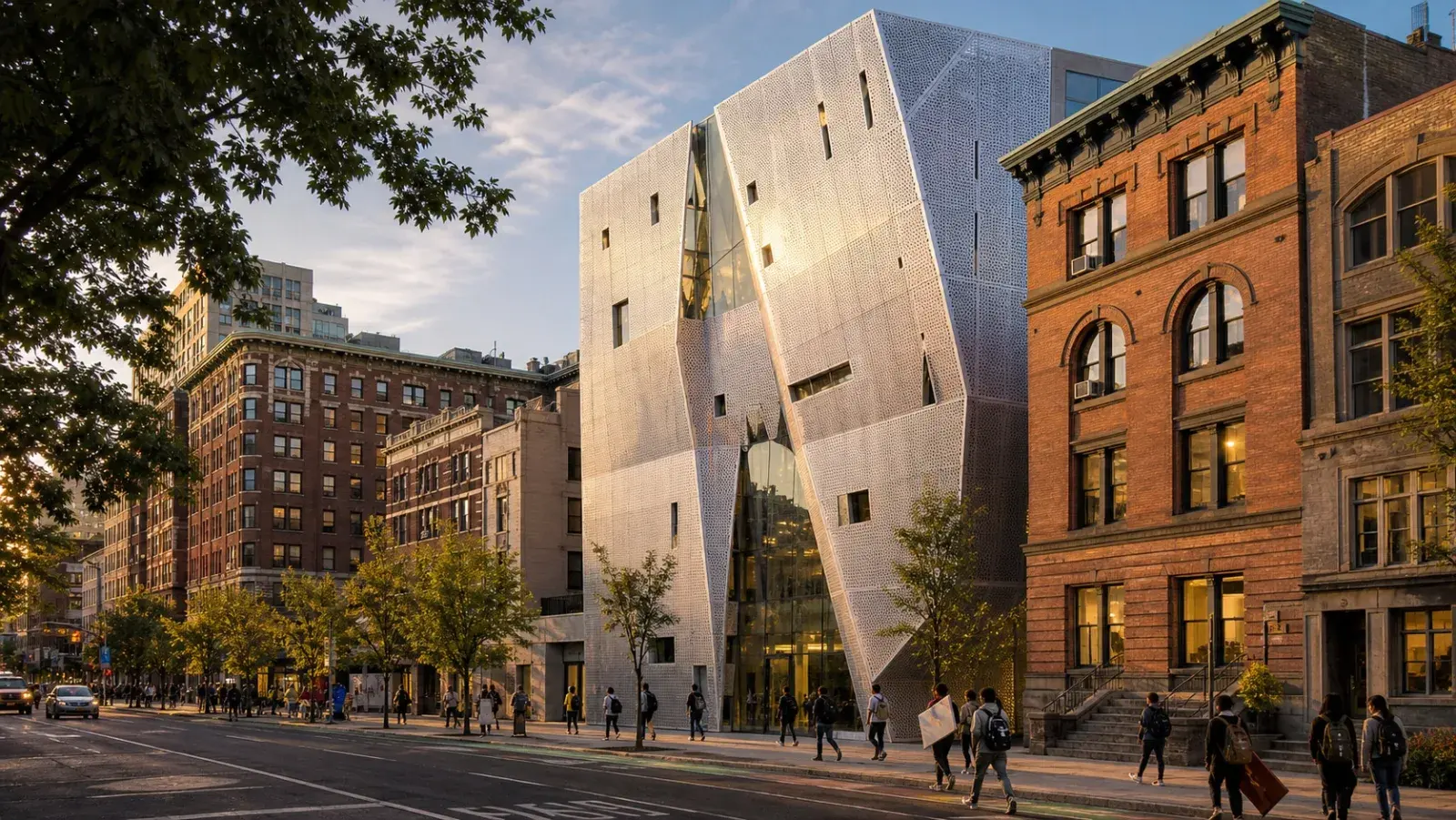

The Cooper Union for the Advancement of Science and Art
Collaboration in the Chrysler Building
Acceptance rate
20.7%
SAT (mid 50%)
1295–1501
Avg net price
$13,269
after aid
Testing
optional
2027 cycle
Sources: the U.S. Department of Education (2024), and The Cooper Union for the Advancement of Science and Art’s admissions site.
Your chances
How hard is it to get in?
Getting in is the hard part. The Cooper Union for the Advancement of Science and Art admitted 20.7% of applicants in its most recent reported class, one of the lowest rates in the country. Realistically it is a reach for every applicant, no matter how strong.
Admitted students cluster near the top of the testing range: the middle 50% score 1295–1501 on the SAT and 28–34 on the ACT. Scores at or above that band keep you in contention, but they do not decide it.
The real question is not your odds but your move. That is where Spike comes in: it reads your profile against what The Cooper Union for the Advancement of Science and Art actually rewards, and tells you what to do next.
What they value
Advancement of Science and Art
Peter Cooper wanted his graduates to acquire the technical mastery and entrepreneurial skills, enrich their intellects and spark their creativity, and develop a sense of social justice that would translate into action.
The Cooper Union offers education in art, architecture, and engineering, as well as courses in the humanities and social sciences.
- The Irwin S. Chanin School of Architecturedesign sequence, studio test
- School of Artvisual imagination, hometest
- Albert Nerken School of EngineeringSTEM, technical mastery
Verified from cooper.edu and cooper.edu and cooper.edu and cooper.edu and cooper.edu and cooper.edu and cooper.edu and cooper.edu and cooper.edu.
The essays
Supplemental essay prompts
The current prompts, straight from the application. These change year to year, so most guides you will find are a cycle behind.
The Cooper Union is a small, highly specialized, and academically challenging school in New York City. Beyond these traits, what specific aspects of our community and resources excite you? In what ways are you inspired to contribute to and benefit from our learning community?
Up to 350 words
What drives your interest in pursuing your chosen major (e.g., Chemical Engineering, Civil Engineering, Electrical Engineering, Mechanical Engineering, or Computer Science)? How do you envision engaging with Cooper's labs, research opportunities, and faculty?
Up to 350 words
Identify a challenge facing a community you identify with or care about. Explain how your experiences and perspective influence the way you would approach a solution.
Up to 250 words
Every prompt, with how to approach each →
Verified from https://www.cooper.edu.
Cost and aid
What you will actually pay
The sticker price is about $64,190, but that is not what most families pay. After need-based aid, the average net price is $13,269.
Every enrolled undergraduate student is awarded a half-tuition scholarship valued at $22,275 per school year.
Ten years after enrolling, graduates earn a median of $83,847.
Verified from https://www.cooper.edu and the U.S. Department of Education.
Campus life
The feel of the place
“High schoolers in the Summer STEM program develop prototypes with microcontrollers, while artists and engineers collaborate on exhibitions installed in landmark buildings, reflecting a vibrant, hands-”
Stalemate, an exhibition by Cooper artists and engineers, was installed in the landmark building's arcade.
Quick answers
The Cooper Union for the Advancement of Science and Art FAQ
- Is The Cooper Union for the Advancement of Science and Art test-optional?
- For the 2027 application cycle, standardized testing at The Cooper Union for the Advancement of Science and Art is optional.
- How hard is it to get into The Cooper Union for the Advancement of Science and Art?
- Very hard. The Cooper Union for the Advancement of Science and Art admits 20.7% of applicants, and the middle 50% of admitted students score 1295 to 1501 on the SAT. Treat it as a reach for every applicant.
- How much does The Cooper Union for the Advancement of Science and Art cost?
- The list price is about $64,190, but the average price families actually pay after aid is $13,269.
- Is The Cooper Union for the Advancement of Science and Art worth it?
- Graduates earn a median of $83,847 ten years after enrolling, and 81% graduate within six years. Value depends on your aid offer and your goals, which is exactly what Spike helps you weigh.
Launching soon
Ask Spike anything about The Cooper Union for the Advancement of Science and Art.
Spike answers from The Cooper Union for the Advancement of Science and Art’s own site, then helps you figure out your move. Join the waitlist to get in early.
One email when Spike opens. No card, no account. About the waitlist.